
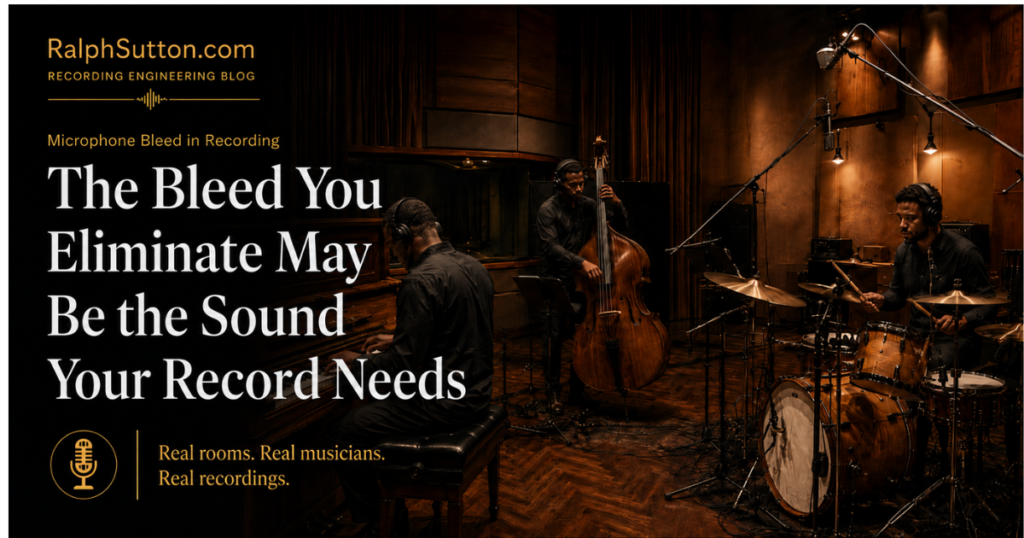
Microphone bleed in recording is often treated as a problem before anyone asks what it may be contributing to the music.
Engineers are often taught to treat microphone bleed as a problem.
Keep the drums out of the piano microphones.
Keep the guitar amplifier out of the drum microphones.
Keep the bass out of everything.
Separate the musicians.
Build walls.
Close doors.
Increase isolation.
There are good reasons for doing those things.
Uncontrolled bleed can create phase problems, reduce clarity, limit editing choices, and make balance difficult later.
But microphone bleed in recording is not automatically damage.
Sometimes it is part of the sound of musicians performing together.
The snare entering the piano microphones may help the piano feel connected to the rhythm section.
The drums, bass, guitar, piano, and Rhodes may begin to feel like one musical event rather than five isolated recordings placed beside one another.
That controlled bleed can give the bed of the song movement, depth, and physical reality.
Once that foundation is complete, the remaining instruments can be overdubbed around a rhythm section that already feels alive.
That is the part of microphone bleed that is often misunderstood.
The goal is not to collect the cleanest possible set of individual tracks.
The goal is to record a performance that feels like a record.
Those are not always the same thing.
Complete isolation can give the engineer greater control.
It can also remove some of the natural interaction, depth, and shared space that made the musicians sound connected in the room.
The question is not:
How do I eliminate all microphone bleed?
The better question is:
What is this bleed adding to the record, and what is it preventing me from doing?
That is where judgment begins.
Some bleed strengthens the image.
Some bleed weakens it.
Some creates cohesion.
Some creates confusion.
Some helps the groove feel physical.
Some makes the mix collapse when a microphone is moved or muted.
The engineer must know the difference before reaching for another isolation panel.
Because the bleed you are trying to eliminate may be carrying the very thing you will later struggle to restore with reverb, room simulation, editing, and mixing.
It may be carrying the sound of the musicians hearing one another, responding to one another, and occupying the same musical space.
And once that relationship has been removed from the recording, it may be impossible to manufacture convincingly later.
Microphone Bleed in Recording Is Not Automatically a Problem
Microphone bleed in recording occurs when a microphone captures sound from an instrument other than the source it was primarily placed to record.
The snare enters the piano microphones.
The guitar amplifier enters the drum microphones.
The piano enters the room microphones.
The drums enter nearly everything.
That is the technical reality of recording musicians together in the same space.
But the presence of bleed does not automatically mean the recording has been damaged.
What matters is what the bleed is doing to the music.
During basic tracking, the drums, bass, guitar, piano, and Rhodes form the bedrock of the song. They are not merely five separate instruments producing five separate tracks.
They are building the body of the record together.
When the musicians can see, hear, and respond to one another, the rhythm section begins functioning as one large musical instrument. The controlled bleed captured during that process can become part of the movement, depth, and physical reality of the recording.
The snare entering the piano microphones may help the piano feel attached to the rhythm section.
The sound of the drums entering the guitar or room microphones may give the groove greater size and dimension.
The shared room sound around the instruments may help the listener believe that the musicians occupied one musical space.
That does not mean every type of bleed is useful.
A loud guitar amplifier entering every drum microphone may reduce control.
Excessive cymbal bleed may make the top end harsh or difficult to balance.
Poor positioning may create phase relationships that weaken the drums when microphones are combined.
An instrument entering another microphone at the wrong level or tone may make editing and mixing more difficult.
Those are real problems.
But those problems do not prove that all bleed should be eliminated.
They prove that bleed must be controlled.
Control Is Different From Elimination
Complete isolation can give the engineer more independent control over each track.
It can also remove some of the shared sound that made the rhythm section feel connected in the room.
That is the tradeoff.
The goal is not to allow every instrument to spill everywhere without thought.
The goal is to position the musicians, amplifiers, microphones, and isolation so the useful relationships remain while the damaging ones are reduced.
That requires listening before recording.
Ask:
- Does the bleed strengthen the groove?
- Does it make the instruments feel connected?
- Does it add useful depth or room?
- Does it improve or weaken the tone when the microphones are combined?
- Will it limit an important balance or editing decision later?
- Does the rhythm section feel more alive with the bleed present?
Those questions are more useful than asking only:
How can I make every track completely clean?
A clean track is not automatically a musical track.
A technically isolated recording can still feel small, disconnected, or artificial.
A recording with controlled bleed can feel dimensional, physical, and believable.
The Bed Must Already Feel Like Music
The basic tracking session should produce more than raw material for the mix.
The drums, bass, guitar, piano, and Rhodes should already begin sounding like the body of the song.
That does not mean the balance is finished.
It does not mean the recording is perfect.
It means the musical relationships are present.
The groove moves.
The instruments breathe together.
The rhythm section feels like a shared event.
Once that foundation has been captured, Hammond B3, horns, percussion, and other parts can be overdubbed around a bed that already feels alive.
The overdubs are then joining a record.
They are not being asked to manufacture the life that was missing from the basic tracks.
Listen to the Bleed in Context
A bleed sound that seems unattractive by itself may become useful when heard with the complete rhythm section.
The off-axis snare in the piano microphone may sound thin in solo.
The drum spill in the guitar microphone may sound imperfect alone.
The room information around several microphones may appear unnecessary when each track is isolated.
But the record is not heard one microphone at a time.
Listen to what happens when the tracks are combined.
Does the snare become wider?
Does the piano sit more naturally inside the groove?
Does the room begin to connect the instruments?
Does the rhythm section feel more like one performance?
Solo can help identify a problem.
Context determines whether it is actually a problem.
Controlled Bleed Can Carry the Reality of the Session
Listeners may not consciously identify microphone bleed.
They may never say:
I hear the snare entering the piano microphones.
They respond to the result.
The record feels real.
The rhythm section feels physical.
The musicians sound connected.
The performance appears to occupy a believable space.
That sense of reality can be difficult to recreate after the instruments have been completely separated.
Reverb can add space.
Room simulation can add ambience.
Mixing can create depth.
But those processes are not identical to capturing musicians interacting in the same room at the same moment.
Controlled bleed contains timing, tone, distance, and interaction that belong to the original performance.
That is why microphone bleed in recording is not automatically a problem.
Sometimes it is part of the record.
The goal is not to eliminate every trace of bleed. The goal is to control it so the rhythm section can feel like one large musical instrument.
Controlled Bleed and Uncontrolled Bleed Are Not the Same Thing
The argument for microphone bleed is not an argument for careless recording.
There is a major difference between allowing useful sound to move naturally through the room and losing control of the session because every source is entering every microphone at an unusable level.
Controlled bleed supports the record.
Uncontrolled bleed limits the record.
That distinction begins before the first take.
It begins with:
- The arrangement
- Musician placement
- Instrument balance
- Amplifier location
- Microphone choice
- Polar pattern
- Distance
- Sight lines
- Isolation
- The sound of the room
The engineer must decide which relationships should be preserved and which ones must be reduced.
Useful Bleed Supports the Primary Sound
A microphone should still capture its intended source with enough authority that the track remains useful.
The piano microphones should sound like piano microphones.
The guitar microphone should still give the guitar a dependable direct sound.
The drum microphones should provide a strong, coherent picture of the kit.
The bleed surrounding those sources may add connection and depth, but it should not overwhelm the sound the microphone was placed to capture.
That is one way to judge whether the bleed is controlled.
Ask:
Is the microphone still doing its primary job?
If the answer is no, the bleed may be controlling the microphone rather than the engineer controlling the bleed.
The Level of the Musicians Matters Before Microphone Placement
Microphone technique cannot solve every balance problem created in the room.
If the drummer is playing far louder than the piano, the drum spill into the piano microphones may become difficult to manage.
If a guitar or Rhodes amplifier is unnecessarily loud, it may enter the drum and piano microphones with more level than the arrangement requires.
If the musicians are not balancing themselves as an ensemble, the microphones will capture that imbalance.
This is why recording musicians together begins with the musicians listening to one another.
The room balance comes before the control-room balance.
A rhythm section that understands dynamics can create useful bleed.
A rhythm section playing without regard for the other instruments can create contamination that no microphone pattern will completely solve.
Positioning Determines What the Microphones Hear
Small changes in musician and microphone placement can produce major changes in bleed.
Turning a microphone slightly may place an unwanted source closer to the microphone’s area of rejection.
Moving an amplifier farther away may reduce its dominance without removing it from the musical environment.
Changing the direction of the piano opening may alter how much drum energy enters the piano microphones.
Adding a carefully placed gobo may control a harsh reflection while preserving sight lines and musical communication.
Moving the musicians should not be treated only as a visual or logistical decision.
Placement is part of the sound.
The engineer is shaping the relationship between direct sound, off-axis sound, and room sound before reaching for EQ.
Isolation Should Be Used With Purpose
Isolation is useful.
It can protect the piano microphones from excessive drum spill.
It can prevent an amplifier from dominating the room.
It can give the engineer enough control to balance the rhythm section later.
But isolation should solve a specific problem.
It should not automatically separate the musicians so completely that they no longer feel like they are playing together.
The goal is not maximum isolation.
The goal is the amount of isolation the record requires.
That may mean:
- Placing an amplifier in another room
- Using a gobo around part of an instrument
- Adjusting the direction of the musicians
- Reducing amplifier volume
- Using direct signal paths where appropriate
- Preserving visual contact while controlling sound
- Allowing selected microphones to carry the shared room
Every choice should protect both the sound and the performance.
Phase Relationships Reveal Whether the Bleed Is Helping
Bleed becomes part of the sound when microphones are combined.
That means timing and phase relationships matter.
A snare may sound full through the direct microphone and weaker when the piano microphones are added.
The low end of the kit may lose authority when room and close microphones are combined.
A guitar may become hollow because its direct signal and the sound entering another microphone are not working together.
The individual tracks may sound acceptable in solo while the combined image becomes smaller.
That is a warning.
Controlled bleed should not merely sound interesting by itself.
It should strengthen the complete rhythm section when the microphones are heard together.
Listen in context and check:
- Does the snare become stronger or thinner?
- Does the kick retain weight?
- Does the piano become more connected or more cloudy?
- Does the guitar gain dimension or lose focus?
- Does the stereo image become wider or less stable?
- Does the groove feel larger or more confused?
The combined sound tells the truth.
Editing Flexibility Is Part of the Decision
Bleed can become a serious problem when the production requires extensive editing.
If a piano microphone contains a large amount of snare, moving the piano performance may also move the snare spill.
If a guitar part must be replaced, its sound may remain audible across other microphones.
If drum timing requires major correction, the drum bleed in the piano or guitar tracks may expose the edit.
That does not mean the engineer should record every session as though extreme editing will be required.
It means the engineer should understand the production.
A prepared rhythm section performing a well-rehearsed arrangement may benefit from a more open recording approach.
A session expected to involve major replacement, rearrangement, or detailed timing reconstruction may require greater isolation.
The correct amount of bleed depends partly on how the recording will be used after tracking.
Control Preserves Options Without Removing Life
The engineer is balancing two responsibilities:
- Capture the musicians as one musical body.
- Preserve enough control to complete the record.
Too much isolation may produce clean tracks that feel disconnected.
Too much uncontrolled spill may create a performance that feels alive but becomes difficult to balance, edit, or shape.
The skill is in finding the middle.
Controlled bleed keeps the sound of the musicians interacting while preventing one source from taking over microphones that belong to another part of the rhythm section.
That is not an accident.
It is part of designing the recording.
Controlled bleed preserves the relationship between the musicians without surrendering control of the record.
The Rhythm Section Should Sound Like One Large Musical Instrument
The drums, bass, guitar, piano, and Rhodes are not merely separate instruments being recorded at the same time.
During basic tracking, they form the body of the song.
Each musician has an individual responsibility, but the rhythm section succeeds through the relationships between those responsibilities.
The kick drum affects the way the bass note feels.
The length of the bass note affects the space around the piano and guitar.
The piano helps establish harmony and movement.
The guitar may reinforce the groove, answer the vocal, or create rhythmic space.
The Rhodes can add weight, texture, and harmonic color without separating itself from the foundation.
When those relationships are working, the rhythm section begins to behave like one large musical instrument.
Controlled bleed can help the recording preserve that behavior.
The Sound of the Bed Is More Than the Sum of the Tracks
It is possible to capture an excellent drum sound, a strong bass sound, a clear piano, and a well-recorded guitar while still failing to capture the rhythm section.
Each instrument may sound impressive in isolation.
But when the tracks are played together, the foundation may feel divided.
The drums appear to occupy one space.
The piano appears to occupy another.
The guitar feels placed beside the rhythm section rather than inside it.
The bass may connect technically with the kick while lacking the physical sense of both musicians shaping the groove together.
That is where the difference between recording instruments and recording a rhythm section becomes clear.
A rhythm section is not created merely by combining tracks.
It is created through shared time, shared dynamics, shared space, and musical response.
Controlled bleed can carry part of that shared experience into the recording.
Bleed Can Reinforce Musical Relationships
The snare entering the piano microphones may help the backbeat feel physically connected to the harmony.
A small amount of piano or guitar entering the room microphones may help those instruments feel attached to the drums rather than layered onto them later.
The sound of the room reaching several microphones at slightly different levels and distances can create depth that belongs to the actual performance.
These relationships are not always obvious when the tracks are soloed.
They become apparent when the rhythm section is heard as a complete bed.
The snare may feel wider.
The piano may settle more naturally into the groove.
The guitar may gain dimension.
The room may begin to describe one musical event instead of several isolated sources.
That shared sound can help the listener feel that real musicians occupied the same moment.
The Listener Does Not Hear the Session as a Track List
The listener does not experience the record as:
- Kick microphone
- Snare microphone
- Bass track
- Guitar track
- Piano microphones
- Rhodes track
- Room microphones
The listener experiences the result as music.
They feel whether the foundation moves.
They feel whether the groove has weight.
They feel whether the musicians sound connected.
They feel whether the record has physical reality.
The engineer must therefore think beyond the independent quality of each track.
The more important question is:
What happens to the rhythm section when these microphones are combined?
If muting every source of bleed makes the bed smaller, flatter, or less believable, the bleed may have been contributing something important.
If opening the shared microphones creates confusion, harshness, or loss of focus, the bleed may need greater control.
The decision belongs to the record, not to a rule about isolation.
Amplifiers Must Be Managed Deliberately
Guitar, bass, and Rhodes may involve amplifiers, direct signals, or a combination of both.
An amplifier can contribute tone, movement, and physical energy.
It can also dominate the room and enter microphones at levels that reduce control.
The answer is not automatically to remove the amplifier from the process.
The answer is to decide how much of its sound belongs in the shared recording environment.
That may require:
- Lower amplifier volume
- Greater distance from the rhythm section
- A different direction or angle
- Placement behind a gobo
- Moving the amplifier to another room
- Using a direct signal alongside the amplifier
- Preserving sight lines while controlling acoustic spill
The amplifier should support the rhythm section without taking control of every open microphone.
Useful bleed comes from intention.
The Bed Should Already Feel Alive
When basic tracking is complete, the rhythm section should already feel like the body of the record.
The groove should move.
The instruments should respond to one another.
The dynamics should make musical sense.
The foundation should possess enough depth, cohesion, and emotional direction that later overdubs are joining something that already lives.
Hammond B3, horns, percussion, background vocals, and other elements can then be added around that foundation.
Those overdubs may expand the arrangement.
They may deepen the emotion.
They may strengthen transitions, color, and impact.
But they should not be responsible for manufacturing the life that the rhythm section failed to create.
The bed must carry the record before the decorations arrive.
Isolation Should Not Break the Musical Body
There are times when greater separation is necessary.
A loud amplifier may need to be moved.
The piano may require protection from excessive drum spill.
A difficult room may require more gobos.
The production may demand greater editing flexibility.
But every isolation decision should be measured against the musical cost.
Does the drummer still feel connected to the bass player?
Can the musicians still see and respond to one another?
Does the piano still feel attached to the groove?
Has the recording gained control while losing physical reality?
Isolation is successful when it protects the record without dismantling the musical body that is creating it.
Listen to the Bed Before Thinking About Overdubs
Before moving forward, listen to the basic tracks as a complete musical statement.
Do not ask only whether every instrument was captured cleanly.
Ask:
- Does the rhythm section move as one?
- Does the groove feel physical?
- Do the instruments appear to occupy the same record?
- Does the bed have depth without losing clarity?
- Is the bleed strengthening the relationships or clouding them?
- Does the foundation already feel alive?
If the answer is yes, the overdubs have something meaningful to join.
If the answer is no, more layers may only hide the weakness temporarily.
The bed of the song is not a collection of ingredients waiting to become music later.
It should already be music.
The bed of the song should already feel like one large musical instrument before the first overdub is recorded.
The Song Determines How Much Bleed Belongs in the Recording
There is no correct amount of microphone bleed for every recording.
The right amount depends on the song, the arrangement, the musicians, the room, and the way the finished record is supposed to feel.
A rhythm section playing a spacious ballad may benefit from hearing more of the room and more of the natural relationship between the instruments.
A dense, aggressive arrangement may require tighter control so the drums, piano, guitar, bass, and Rhodes remain defined when the production becomes larger.
A record built around complete performances may allow more of the shared environment to remain.
A production expected to involve substantial editing, replacement, or rearrangement may require greater separation.
The engineer should not begin with a fixed belief that bleed is good or bad.
The engineer should begin with the music.
The Arrangement Reveals What Must Remain Clear
The arrangement determines where instruments occupy space.
When the piano and guitar are both active in the same register, uncontrolled spill may make the middle of the recording crowded.
When the Rhodes is sustaining underneath a busy drum pattern, too much cymbal energy in the Rhodes microphones may make the texture harsh.
When the bass and kick are responsible for carrying a deep, open groove, poor phase relationships across the room microphones may weaken the center of the record.
But when the arrangement leaves room between the instruments, controlled bleed can help that space feel natural.
A piano chord may decay into the room while the drummer leaves space around the backbeat.
The guitar may answer the vocal rather than competing continuously with the rhythm section.
The bass may allow the kick to speak clearly.
In that setting, the shared sound can become part of the phrasing.
The arrangement tells the engineer which relationships should be preserved and which ones must remain independently controllable.
Ask About Manufactured Breakdowns Before Tracking
When I am recording a Funk session, I ask the producer directly:
Will there be manufactured breakdowns of this song?
I need that answer before deciding how much isolation the session requires.
Controlled bleed may make the complete rhythm section feel alive while the drums, bass, guitar, piano, and Rhodes are all playing together. But that same bleed can become a problem when the producer later wants to remove instruments and expose only part of the groove.
The guitar may be muted, but its amplifier may still be audible in the drum, piano, or room microphones.
The piano may be removed, but parts of its performance may remain inside the surrounding microphones.
The drums may be reduced to kick and snare, while cymbal and room bleed continue revealing the original full performance.
The breakdown may be clean on the screen while the microphones continue telling the listener that the complete rhythm section was playing.
A Performed Breakdown and a Manufactured Breakdown Require Different Planning
When the musicians perform the breakdown as part of the arrangement, the bleed changes naturally with the performance.
The guitarist stops playing.
The pianist leaves space.
The drummer changes the pattern.
The bass player adjusts the groove.
The entire room reflects the breakdown because the musicians actually performed it.
A manufactured breakdown is different.
The full rhythm section may have performed continuously, and the breakdown is created later by muting or editing selected tracks.
In that situation, the bleed captured across the microphones may prevent the producer from achieving the separation the manufactured section requires.
That does not mean the session must be completely isolated.
It means the engineer needs to know what the production intends to do with the recording.
Funk Arrangements Make This Especially Important
One of the most important arrangement questions may concern sections that have not yet been fully created. When I am recording a Funk session, I ask the producer directly: Will there be manufactured breakdowns of this song?
Funk records often depend on contrast.
The full rhythm section may suddenly reduce to drums and bass.
The groove may drop to a guitar figure.
The record may expose the kick, snare, bass, or clavinet before the complete band returns.
Those breakdowns can create tension, release, movement, and excitement.
But they must be considered during tracking.
When the arrangement is well planned, the musicians can perform the breakdowns as part of the take.
When the breakdowns will be constructed later, the engineer may need:
- Greater amplifier isolation
- Tighter microphones on amplified instruments
- More controlled room levels
- Additional direct signals
- Careful use of the room microphones
- Separate passes for certain exposed sections
- A clear understanding of which instruments may later be removed
The microphone setup must preserve the life of the complete rhythm section without making the producer’s intended breakdowns impossible.
The Density of the Production Changes the Decision
A small rhythm-section recording may benefit from a more open sense of space.
The listener can hear the air around the drums.
The piano can remain dimensional.
The guitar can occupy a believable position in the room.
The controlled bleed helps the recording feel physical.
As the production becomes denser, every additional layer competes for room in the soundstage.
Hammond B3, horns, percussion, background vocals, strings, and other overdubs may eventually surround the original bed.
If the basic tracks are already cloudy, those additions can make the record difficult to organize.
The engineer must therefore think beyond the immediate pleasure of the room sound.
Ask:
Will this shared sound continue helping the record after the arrangement is complete?
Bleed that feels exciting with five musicians may become excessive when fifteen more parts are added.
The recording process must anticipate the finished production.
The Style of Music Affects the Meaning of Space
Some records are strengthened by hearing the musicians occupy a common environment.
The room becomes part of the emotion.
The backbeat feels wider.
The piano feels attached to the drums.
The rhythm section has movement and physical depth.
Other records depend on a tighter, more controlled image.
The kick and bass may need to remain extremely focused.
The guitar may need to change position or level substantially between sections.
The piano may need detailed control because the arrangement becomes dense.
Neither approach is more musical by definition.
The question is what the song is asking the recording to communicate.
A warm, open sound may support intimacy, tradition, and ensemble interaction.
A tighter sound may support precision, impact, contrast, and production flexibility.
The engineer’s responsibility is to recognize the difference.
The Musicians’ Preparation Changes What Is Possible
A prepared rhythm section gives the engineer more freedom.
When the arrangement is understood, the dynamics are controlled, and the musicians can deliver complete performances, the recording can preserve more of their natural relationship.
The bleed becomes part of a confident musical event.
When the arrangement is still changing, the parts are uncertain, or substantial replacement is expected, the same amount of bleed may become a liability.
A guitar part that later changes may remain embedded in the piano and drum microphones.
A piano phrase that must be moved may carry the original backbeat with it.
A drum correction may become audible across microphones that captured the entire room.
The amount of bleed the session can support is related to how much the production trusts the performance.
That is not a judgment of the musicians.
It is a practical recording decision.
The engineer must know what is settled and what is still being built.
Dynamics Must Be Considered Across the Entire Song
A setup may work beautifully during the verse and fail during the chorus.
The guitar amplifier may sit comfortably in the room at the lower level, then overwhelm the piano microphones when the guitarist plays with greater intensity.
The cymbals may feel balanced during the intro and dominate the room during the strongest section.
The Rhodes may fit inside the bed until the arrangement becomes fuller and its amplifier begins filling every open microphone.
That is why the most demanding section should be tested before complete takes begin.
The engineer must hear how the bleed behaves when the musicians reach the full emotional and dynamic range of the song.
Useful bleed should survive the arrangement.
It should not become uncontrollable when the music becomes powerful.
Bleed Can Help Create Contrast Between Sections
The amount of room and shared sound does not always need to remain identical throughout the record.
A verse may feel intimate and focused.
A chorus may open into a larger acoustic image.
A bridge may become more spacious.
A final section may allow the room to carry more of the emotional weight.
Some of that contrast can be shaped during mixing by changing the level of room microphones and shared perspectives.
But the possibility must exist in the recording.
The direct microphones must provide enough control for intimacy.
The room and bleed microphones must provide enough dimension for expansion.
A strong tracking setup gives the mixer both.
That is another reason controlled bleed is valuable.
It does not force the record to remain open or ambient at all times.
It provides an additional perspective that can be used according to the structure of the song.
Dolby Atmos Makes the Finished Soundscape Part of the Tracking Decision
When the record is intended for Dolby Atmos, the song’s spatial identity must be considered before recording begins.
The position of the musicians within the room can become part of the listener’s experience.
The room microphone array may represent specific areas of the Atmos soundstage.
The bleed captured through those microphones can establish the depth, width, height, and perspective of the performance environment.
In that situation, the amount and character of bleed are not merely technical matters.
They are compositional decisions within the soundscape.
The engineer must anticipate:
- Where the listener will appear to be located
- How close or distant the rhythm section should feel
- Which parts of the room should surround the listener
- How later overdubs will enter the established space
- Whether the ambience supports the emotion of the song
- How amplifier energy affects the clarity of the room array
When done correctly, the room does not feel like an effect added behind the musicians.
It feels like the place where the music is happening.
Do Not Use Bleed to Make the Record Seem More Authentic
Bleed should not be preserved simply to claim that the recording is natural, vintage, or authentic.
That turns a musical decision into an aesthetic slogan.
Some bleed carries life.
Some carries noise.
Some provides connection.
Some creates clutter.
Some supports the soundstage.
Some prevents the mix from moving.
The value is not in the presence of bleed.
The value is in what the bleed contributes to the finished record.
The engineer must remain honest about the result.
If the recording feels stronger without a particular microphone, mute it.
If the rhythm section becomes more believable when the shared sound is added, preserve it.
If the room array creates a powerful spatial image, build around it.
If it weakens the song, change the setup.
The music is the final authority.
The Finished Record Must Guide the Beginning
The best time to decide how a recording should feel is not after every track has been captured.
That decision begins before the musicians enter the first complete take.
The engineer should already be considering:
- How intimate or expansive the record should feel
- How much editing the production may require
- Which instruments must remain independently controllable
- How the arrangement will grow
- Whether the room will become part of the sound
- Whether the recording is being designed for stereo, Dolby Atmos, or both
- How the overdubs will join the acoustic world of the rhythm section
These decisions determine whether the bleed becomes useful ambience, musical glue, spatial information, or a problem that must be repaired later.
The recording should begin with the finished experience in mind.
Before deciding how much bleed belongs in a Funk recording, ask whether the breakdowns will be performed by the musicians or manufactured after the session.
Useful Bleed Is Designed Before the First Take
Controlled bleed is not something the engineer discovers after the session.
It is created through decisions made before the musicians record the first complete take.
The placement of the drums affects every microphone in the room.
The level and direction of the guitar amplifier affect the drum, piano, and room microphones.
The position of the piano affects how much of the kit reaches its microphones.
The direction of a microphone determines which instruments reach the front, sides, and rear of its pattern.
The height of a gobo can control one sound while allowing another to travel naturally through the room.
Every part of the setup changes the relationship between direct sound, bleed, and room sound.
That is why the session must be designed around the rhythm section as a whole.
The engineer is not merely finding a good sound for each instrument.
The engineer is building an environment in which the drums, bass, guitar, piano, and Rhodes can become one musical body without losing the control needed to finish the record.
Begin With the Sound of the Musicians in the Room
Before placing every microphone, listen to the rhythm section acoustically.
Stand in different parts of the room.
Listen near the drums.
Listen near the piano.
Listen from the center of the room.
Listen from the position where the room microphones may be placed.
Pay attention to:
- Which instrument is dominating the room
- Where the low frequencies become stronger or weaker
- Whether the cymbals are harsh in a particular direction
- Whether the piano feels attached to the drums
- How the amplifier energy travels through the space
- Whether the room adds useful size or distracting reflections
The microphones will capture the relationships that already exist.
If the guitar amplifier is too loud in the room, it will probably be too loud in microphones that were never intended to record it.
If the cymbals are overpowering the piano acoustically, microphone placement alone may not create the separation the record needs.
If the rhythm section sounds disconnected in the room, opening more microphones will not automatically make it cohesive.
The room balance is the first version of the recording balance.
Place the Drums With the Entire Bed in Mind
The drums are often the largest acoustic source during basic tracking.
Their placement affects almost every other microphone.
A drum kit placed only for the best isolated drum sound may create problems for the piano, amplifiers, and room microphones.
Consider:
- How the cymbals project toward the piano
- Where the snare energy travels
- How the kick interacts with the low-frequency behavior of the room
- Whether nearby walls create harsh or uneven reflections
- Whether the room supports the size and tone the song requires
- Whether the drummer can maintain visual communication with the other musicians
The drum position should support the complete rhythm section, not only the drum microphones.
A strong drum sound that destroys the usefulness of the piano microphones may not be a strong session setup.
The goal is to find a position where the kit sounds authoritative while the surrounding instruments remain recordable.
Control Amplifier Energy Before It Controls the Room
An amplifier can become one of the most powerful bleed sources in a tracking session.
Its direct microphone may sound excellent while its room energy creates problems elsewhere.
The amplifier does not always need to be loud to produce the tone the musician needs.
Start by asking whether the volume is serving the music or merely reflecting habit.
Then consider:
- Turning the amplifier away from the drum and piano microphones
- Increasing the distance between the amplifier and sensitive sources
- Raising or lowering the cabinet
- Placing a gobo behind or beside it
- Using a direct signal as an additional option
- Moving the cabinet into another room while keeping the musician with the rhythm section
- Allowing the musician to hear the amplifier through the headphone system rather than through excessive room volume
The musician should still feel connected to the instrument.
The solution should not remove the physical and emotional relationship that helps the performance.
But the amplifier must not become louder in the shared microphones than the song requires.
Use Microphone Rejection Intentionally
A microphone does not only hear what it is pointed toward.
It also hears sound arriving from every other direction according to its polar pattern and off-axis response.
The engineer should therefore aim both sides of the microphone:
- The front toward the sound that should be captured
- The area of greatest rejection toward the sound that should be reduced
A small rotation can change the amount and tone of bleed significantly.
The rejection area of a cardioid microphone may be directed toward an amplifier.
A figure-eight pattern may be useful when its side null can reduce sound from a nearby source.
A tighter pattern may help in one position but produce less natural off-axis tone in another.
The correct pattern is not always the one that provides the most isolation.
It is the one that gives the best relationship between the intended instrument and everything else entering the microphone.
During rhythm-section tracking, off-axis sound is part of the microphone choice.
Distance Changes Both Tone and Bleed
Moving a microphone closer to its intended source usually increases the ratio of direct sound to room and bleed.
That can provide greater control.
But closer placement also changes tone, perspective, proximity effect, and the way the instrument breathes.
Moving farther away can produce a more natural image while allowing more of the room and surrounding instruments into the microphone.
Neither choice is automatically correct.
The question is:
How much direct authority does this microphone need, and how much shared sound can the record support?
A piano recorded too closely may become mechanically detailed while losing the sense of the instrument in the room.
A guitar microphone placed only for maximum isolation may capture a narrow version of the amplifier.
A room microphone placed too close to one source may stop functioning as a picture of the complete rhythm section.
Distance should serve the role of the microphone inside the recording.
Use Gobos as Shaping Tools, Not Walls
A gobo can reduce excessive spill, soften a reflection, or protect a microphone from a dominant source.
But a gobo does not always need to create complete separation.
Its height, angle, position, and distance from the source determine what it controls.
A low gobo may reduce direct amplifier energy while preserving sight lines.
A panel beside the piano may protect the microphones from cymbal wash without enclosing the pianist.
A gobo behind an amplifier may prevent a hard reflection from returning into the room.
A partial barrier may solve the problem while leaving enough shared acoustic information for the rhythm section to remain connected.
The engineer should listen after every placement change.
A gobo may reduce the unwanted sound and also remove useful low-frequency or room information.
It may clean one microphone while making the entire bed feel smaller.
The correct position is the one that improves control without unnecessarily removing life.
Preserve Sight Lines and Musical Communication
The recording setup must work for the musicians, not only the microphones.
The drummer should be able to see the bass player.
The pianist should be able to respond to the drummer and guitarist.
The musicians should be able to communicate without depending entirely on the talkback system.
Visual contact helps musicians respond to:
- Count-ins
- Dynamic changes
- Stops
- Pushes and pulls
- Transitional cues
- Endings
- Improvised decisions
- Subtle changes in intention
A technically isolated setup can become musically expensive when the musicians can no longer see or feel one another.
Whenever possible, solve the acoustic problem without breaking the human connection.
A window, an angled gobo, a lower barrier, or a different musician position may preserve the sight line while still improving separation.
Let Selected Microphones Carry the Shared Sound
Not every microphone needs to contain the same amount of bleed.
Some microphones should provide direct control.
Others can help carry the shared space.
The close microphones may establish focus and authority.
The piano microphones may provide both piano and a useful amount of rhythm-section connection.
The room microphones may describe the physical relationship between the instruments.
The drum overheads may capture more than cymbals. They may help define the kit and its place inside the bed.
The engineer can design layers of perspective:
- Direct sound for control
- Instrument perspective for natural tone
- Shared room sound for cohesion and size
That approach is different from allowing random spill everywhere.
Each microphone has a role.
The useful bleed is distributed intentionally across the recording.
Record the Most Demanding Section First
A soft introduction may make the setup appear more controlled than it will be during the full arrangement.
Test the section where the rhythm section reaches its strongest level.
Have the musicians play the chorus, bridge, or most active groove.
Listen for:
- Cymbal energy in the piano microphones
- Amplifier spill in the room and drum microphones
- Low-frequency buildup
- Phase changes when all microphones are combined
- Whether the room becomes harsh at higher dynamics
- Whether the musicians remain balanced when they play with full commitment
A setup that works only during the quietest section is not ready.
The session must be designed for the actual dynamic range of the song.
Make Adjustments Before the Musicians Spend Their Best Energy
The musicians’ concentration and physical energy are valuable.
Do not wait until several complete takes have been recorded to determine that the guitar amplifier is controlling the room or the cymbals are overwhelming the piano microphones.
Record a short test.
Listen.
Make the largest necessary adjustment.
Record again.
Once the rhythm section sounds connected, controllable, and alive, allow the musicians to concentrate on making music.
Technical preparation should protect the performance, not repeatedly interrupt it.
The engineer’s work before the first complete take creates the freedom the musicians need during the take.
Controlled Bleed Is the Result of Intentional Relationships
Useful bleed does not happen because the engineer ignored isolation.
It happens because the engineer decided:
- Which instruments should share space
- Which sources required greater separation
- Where the amplifiers belonged
- How the microphones should face the room
- What the gobos needed to control
- Which microphones would carry direct sound
- Which microphones would help carry the shared performance
The result should not feel sterile.
It should not feel uncontrolled.
It should feel like musicians playing together inside a recording environment designed to preserve their relationship.
Useful bleed is not an accident. It is the result of designing the room so the rhythm section can breathe together without losing control of the record.
The Bleed Must Serve the Record
Microphone bleed in recording is not automatically a flaw, and it is not automatically an advantage.
During basic tracking, controlled bleed can help the drums, bass, guitar, piano, and Rhodes feel like one musical body. It can preserve the depth, movement, and physical reality of musicians performing together.
But that bleed must be planned around the arrangement, the room, amplifier levels, editing needs, manufactured breakdowns, later overdubs, and the finished soundscape.
The goal is not maximum isolation.
The goal is not maximum openness.
The goal is to preserve enough shared sound to keep the rhythm section alive while maintaining enough control to finish the record according to the needs of the song.
When those decisions are made before the first complete take, microphone bleed stops being an accident.
It becomes part of the recording.
That section replaces the need for any additional technical discussion. It closes the argument cleanly and leads directly into the Guide.
Go Deeper Into Recording Live Musicians
Controlled bleed is only one part of capturing a rhythm section that feels connected, dimensional, and alive. The arrangement, room, musician placement, isolation, monitoring, signal flow, communication, and production plan must work together before the first complete take is recorded.
The Ultimate Guide to Recording Live Musicians in the Studio brings those decisions into a larger recording framework designed to help you think more clearly before the session becomes a repair job.

UJAMAA MEDIA RECORDING GUIDE
The Ultimate Guide to Recording Live Musicians in the Studio
If the recording is weak at the source, everything afterward becomes a repair job. This guide helps you think better before the damage is done.
RECORDING ENGINEERING
Planning a Recording Built Around a Live Rhythm Section?
Controlled bleed, musician placement, amplifier levels, isolation, monitoring, signal flow, and the arrangement must be considered before the first complete take is recorded.
If you are planning a recording built around drums, bass, guitar, piano, Rhodes, or other musicians performing together, send me the project details.
Tell me what you are recording, who is involved, where the session will take place, and what the project needs. I will review the scope, availability, and next steps.
Recording engineering inquiries for rhythm sections, horns, strings, choirs, vocalists, and other live performers.